
Rahnumaye Salik
Guideline for the Spiritual Seeker
Hazrat Shaykh Muhammad Humayun Hanif Naqshbandi Mujaddidi (damat barakatuhum al-aaliya)
The practices of the seeker: cognizance of the heart, muraqabah, the three tasbeehat, the shajrah, contact with the Shaykh, etiquettes with the Shaykh, constant connection with Allah, and the seven lessons of the Naqshbandi order.
Begin these practices and lessons only with the guidance and permission of your own Shaykh. This page is here as a reminder, not as a substitute for the Shaykh.
Overview
The practices of the seeker
In order to follow the spiritual path of the Auliya e Karam, the following prerequisites must be met.
- Wuqoof e Qalbi
- Muraqabah
- The three tasbeehat
- Shajrah
- Raabita
- Aadaab
What these practices mean
Each of these has its own meaning and its own place. They are set out one by one in the pages that follow.
1
Wuqoof e Qalbi
Wuqoof e Qalbi is an Arabic term which means ‘halting your heart’. In tassawuf, however, it means to hold the heart with the remembrance of Allah Subhan O Taala, so it does not diverge and deviate. Wuqoof e Qalbi entails the seeker to devoid the heart from any other thought, except for Allah Subhan O Taala.
True cognizance
True cognizance is achieved by recognizing that Allah Subhan O Taala is the ‘Ever Watchful One’, ‘the Creator’. He is aware of all our deeds and actions; therefore, one must be conscious of his conduct. It involves the constant awareness of the spiritual heart, being the focus of perception, thoughts and feelings, towards Allah Subhan O Taala, at all times.
The importance of Wuqoof e Qalbi
The course of everyday living can muster vain ideas and thoughts, which distract the seeker from the remembrance of Allah Subhan O Taala. Wuqoof e Qalbi guards the heart against these, and keeps it turned towards Allah through the ordinary hours of the day.
2
Muraqabah
Meditation is called Muraqabah in Arabic, derived from the word Raqibun, meaning the watchful one or the vigilant. ‘Ar Raqib’ is one of Allah Subhan O Taala’s attributes, meaning ‘the One Who is Ever Watchful’. Therefore, Muraqabah means an act of guarding the heart and mind.
Muraqabah in the Naqshbandi order means to watch over, or to keep an eye. It implies that the seeker takes care of his spiritual heart and truly believes that he is under the constant watch of the ‘Ever Watchful One’, being Allah.
How to perform Muraqabah in the Naqshbandi order
The seeker must choose a specific time, free from any distractions, on a daily basis. Mobile phones and any other form of interaction should be restricted. It is recommended to meditate with an empty stomach, or a few hours after a meal.
The seeker is advised to perform wudu and sit as per Sunnah or cross legged, facing towards the Qiblah, for at least 45 minutes. The seeker must close his eyes and mouth and try breathing through the nose. All thoughts must emphasize towards the heart, which in turn should concentrate towards Allah.
The seeker should reflect on Allah Subhan O Taala, The Almighty, with all His attributes, free from any flaws. With these thoughts in mind, the seeker should imagine that the light is emanating from Allah Subhan O Taala to the blessed heart of Allah’s Last Prophet, peace be upon him, and through the hearts of the Naqshbandi Mashaikh towards his heart. This is to be visualized for a few seconds only.
Then, the seeker should envision that his heart is being enlightened and purified from any impurities, and humming Ism e Zaat, Allah, Allah, Allah, while the seeker is listening to it.
The importance of Muraqabah
Meditation is considered an integral part of the spiritual path, especially the Naqshbandi order. It leads the seeker to watch over his spiritual heart and attain the true love of Allah Subhan O Taala.
Upholding Shariah and Sunnah
It is imperative to maintain Shariah and uphold Sunnah. The seeker must perform the five obligatory prayers and daily recital of the Quran. Conscious effort should be established to abide by the Shariah and embrace the Sunnah. This includes keeping the beard, wearing Hijab etc. and abstaining from any evil such as smoking, music and photography.
3
The three tasbeehat
The following tasbeehat must be performed one hundred times each, twice daily. The set of four must be performed once after Fajr, to be repeated after Maghrib.
Try to keep one fixed time for all of them together. If that is not possible, complete them at any point in the day.
Istighfar
100 times
اَسْتَغْفِرُ اللهَ تعالىٰ رَبِّىْ مِنْ كُلِّ ذَنْبٍ وَّاَتُوبُ اِلَيْهِ
Durood Shareef
100 times
اَللّٰهُمَّ صَلِّ عَلىٰ سَيِّدِنَا مُحَمَّدٍ وَّعَلىٰ آلِ سَيِّدِنَا مُحَمَّدٍ وَّبَارِكْ وَسَلِّمْ
The third kalima
100 times
سُبْحَانَ اللهِ وَالْحَمْدُ لِلّٰهِ وَلَا اِلٰهَ اِلَّا اللهُ وَاللهُ اَكْبَرُ
After the third kalima is completed
once, at the end
لَا حَوْلَ وَلَا قُوَّةَ اِلَّا بِاللّٰهِ الْعَلِىِّ الْعَظِيْمِ
Note: it should be understood that keeping the five daily prayers and reciting the Quran are a required part of the seeker’s daily routine. Establishing the Sunnah in one’s life is equally important. These are essential pillars for the seeker’s progress.
4
Shajrah
اَلسِّلْسِلَةُ الشَّرِيْفَةُ بِلِسَانٍ عَرَبِىٍّ مُّبِيْن
بِسْمِ اللهِ الرَّحْمٰنِ الرَّحِيْم
اَللّٰهُمَّ صَلِّ عَلىٰ سَيِّدِنَا مُحَمَّدٍ وَّعَلىٰ آلِ سَيِّدِنَا مُحَمَّدٍ وَّبَارِكْ وَسَلِّمْ بِعَدَدِ كُلِّ شَىْءٍ مَّعْلُومٍ لَّكَ
The noble hierarchy of the spiritual order follows. Each name is read after Elahi behurmate. The chain carries forty-one names; the original numbering runs to 42 because it has no entry 09.
- Elahi behurmate Shafi ul Muznebeena Rahmatul lil Aalameena Sayyedena Muhammad ir Rasulilah Sallal lahu Alaihi Wassalam
- Elahi behurmate Khaleefat e Rasul Allah, Sayyedena Ameer ul Momineen Abi Bakr nis Siddiq (radiy Allahu anhu)
- Elahi behurmate Sayyedena Sahib e Rasul Allah Hazrat Salman Farsi (radiy Allahu anhu)
- Elahi behurmate Sayyedena Al Imam al Qasim (rahmatullahi alayh)
- Elahi Behurmate Sayyedena Hazrat Imam Ajjafar Sadiq (rahmatullahi alayh)
- Elahi behurmate Sayyedena Bayazeed nil Bustami (rahmatullahi alayh)
- Elahi behurmate Sayyedena Abi Al Hasan al Kharqani (rahmatullahi alayh)
- Elahi behurmate Sayyedena Abi Al Qasim Gorgani (rahmatullahi alayh)
- Elahi behurmate Sayyedena Ali nil Farmadi (rahmatullahi alayh)
- Elahi behurmate Sayyedena abi Yusuf al Hamdani (rahmatullahi alayh)
- Elahi behurmate Sayyedena Hazrat Khawaja Abdul Khaliq Ghajdwani (rahmatullahi alayh)
- Elahi behurmate Sayyedena Hazrat Khawaja Muhammad Arif nir Riogri (rahmatullahi alayh)
- Elahi behurmate Sayyedena Hazrat Khawaja Mehmood nil Faghnavi (rahmatullahi alayh)
- Elahi behurmate Sayyedena Hazrat Khawaja Azizane Ali nir Raamitni (rahmatullahi alayh)
- Hazrat Khawaja Sayyedena Baba As Samasi (rahmatullahi alayh)
- Elahi behurmate Sayyedena Ameer nil Kulaal (rahmatullahi alayh)
- Elahi behurmate Sayyedena Shaykh al Mashaikh Muhammad Bahauddin Naqshband al Bukhari (rahmatullahi alayh)
- Elahi behurmate Hazrat Ala’uddin al Attar (rahmatullahi alayh)
- Elahi behurmate Sayyedena Hazrat Khawaja Yaqoob as Sarkhi (rahmatullahi alayh)
- Elahi behurmate Sayyedena Hazrat Khawaja Ubaidullah Al Ahrar (rahmatullahi alayh)
- Elahi behurmate Sayyedena Muhammad niz Zahid (rahmatullahi alayh)
- Elahi behurmate Sayyedena Darvaish Muhammad (rahmatullahi alayh)
- Elahi Behurmate Sayyedena Hazrat Khawaja Muhammad nil Amkangi (rahmatullahi alayh)
- Elahi Behurmate Syyedena Hazrat Khawaja Muhammad nil Baqibillah (rahmatullahi alayh)
- Elahi Behurmate Sayyedena o Maulana Ahmad AlFaruqi as Sirhindi (rahmatullahi alayh)
- Elahi Behurmate Sayyedena Muhammad nil Masoom (rahmatullahi alayh)
- Elahi Behurmate Sayyedena Hazrat Khawaja Saifuddin (rahmatullahi alayh)
- Elahi Behurmate Sayyedena Muhammad Mohsin Ad Dahalvi (rahmatullahi alayh)
- Elahi Behurmate Sayyedena Nur Muhammad AlBadayoni (rahmatullahi alayh)
- Elahi Behurmate Sayyedena Mirza Mazhar Janejana (rahmatullahi alayh)
- Elahi Behurmate Sayyedena Ghulam Ali Ad Dahalvi (rahmatullahi alayh)
- Elahi Behurmate Sayyedena Abu Sa’eed nil Ahmad (rahmatullahi alayh)
- Elahi Behurmate Sayyedena Ahmad Saeed nil Madani (rahmatullahi alayh)
- Elahi Behurmate Sayyedena Dost Muhammad nil Qandhari (rahmatullahi alayh)
- Elahi Behurmate Sayyedena Muhammad Usman ad Daamani (rahmatullahi alayh)
- Elahi Behurmate Sayyedena Muhammad Sirajuddin (rahmatullahi alayh)
- Elahi Behurmate Sayyedena Muhammad Fazal Ali Qureshi (rahmatullahi alayh)
- Elahi Behurmate Sayyedena Mohammad Abdul Ghafoor al Abbassi al Madani Wa Noor Ul Allahu Marqadahu wa A’alallahu darajatihi wa nafa’n Allahu bi uloomihi wa Afaz a’laina min barakatihi wa fauzatihi fid duniya wal akhira ameen ya Rabul Alameen (rahmatullahi alayh)
- Elahi Behurmate Sayyedena Abdul Haq al Madni al Abbassi (rahmatullahi alayh)
- Elahi Behurmate Sayyedena Hazrat Maulana Shamsur Rehman Al Abbasi (damat barakatuhum)
- Elahi Behurmate Sayyedena Hazrat Shaykh Humayun Hanif (damat barakatuhum)
The reader then closes with this dua, saying his or her own name in place of the words marked:
Irham al haqeer al faqeer (your own name) al Naqshbandi al Mujjadadi al ghafoori war zuqni kamala fi martabatil Ehsaan behurmate Sayyedena Adnan wa Behurmate Saadaat hadehis Silsilatish shareefati min Sayyedena Abi Bakr nis Siddique Razi Allah Taala Anhu I’lash Shaykh Humayun Hanif Naqshbandi Mudazillahu aali wa sallal lahu Taala Ala’ khair e khalqihi Muhammadin wa Alihi wa Ashabihi ajmaeen bi Rahmatihi wa howa Arham Ar Raheemeen.
The same shajrah, in the original manuscript pages:
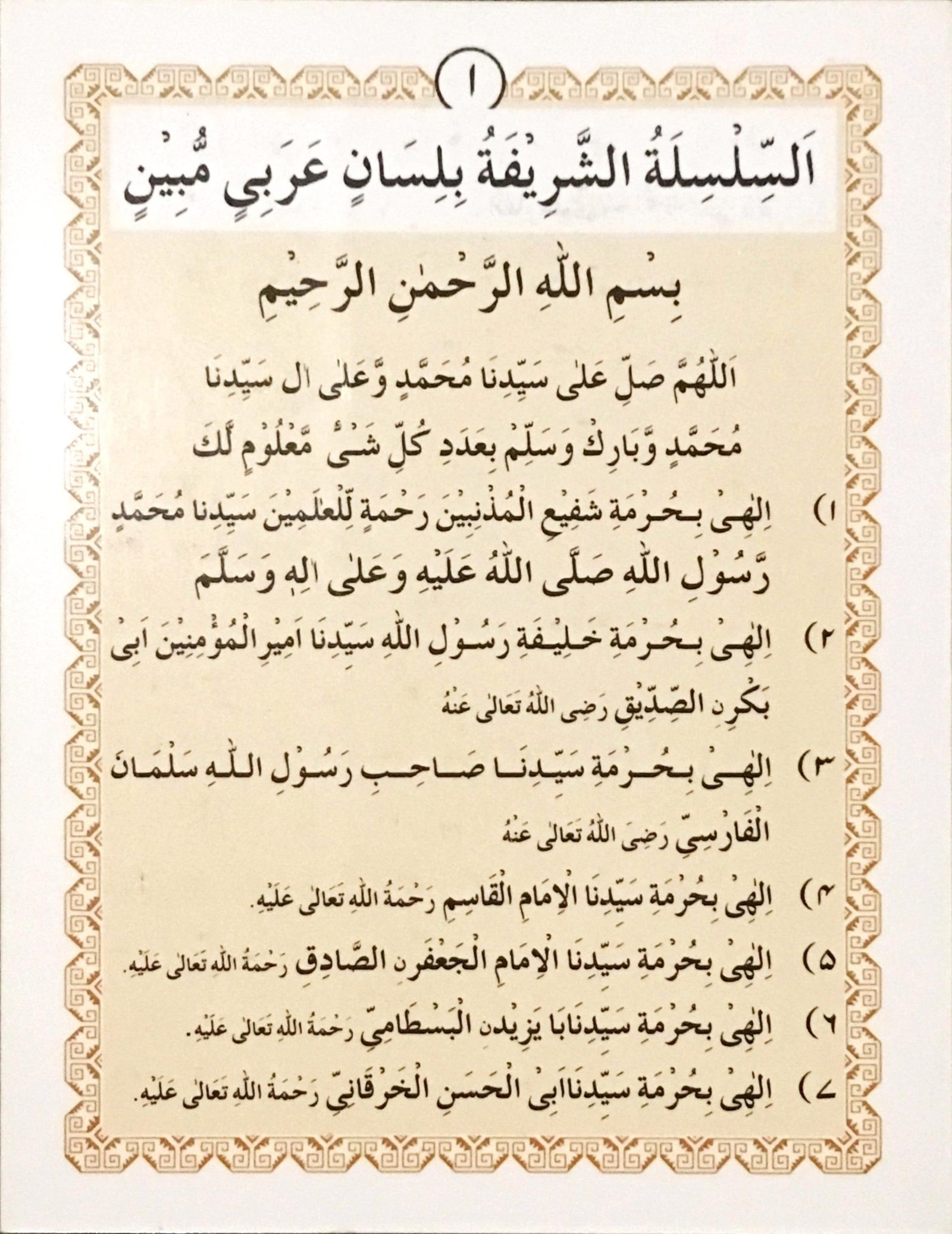


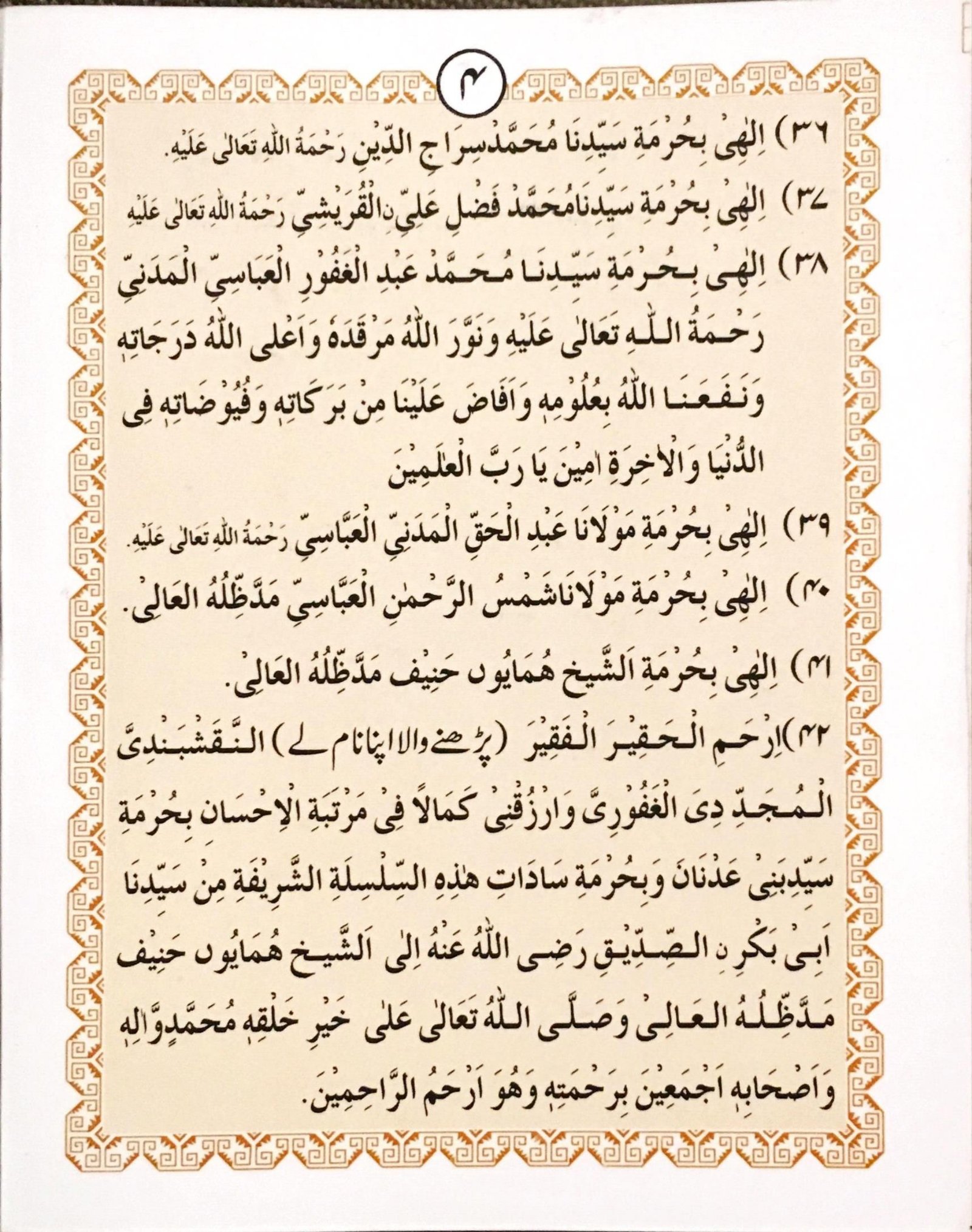
In the closing dua the reader names himself and asks Allah for kamaalan fi martabatil Ehsaan, perfection in the station of Ihsan. That is the object of this whole path.
5
Raabita
Raabita is communication with the Shaykh. In the Naqshbandi order, it is imperative to seek guidance for spiritual and worldly matters from the Shaykh.
The seeker must contact the Shaykh once every fifteen days, to report his spiritual matters and routines. This also includes matters pertaining to following Shariah and Sunnah. One must report all matters truthfully, without any exaggeration, and follow the Shaykh’s advice regarding those matters.
The etiquettes regarding calling or visiting, as explained below, have to be strictly followed for contacting or visiting the Shaykh.
6
Aadaab
Aadaab are the etiquettes with the Shaykh. The seeker cannot reach his destination by following the path of spirituality on his own accord. It is the duty of the Shaykh to connect the seeker with Allah; therefore, the seeker must accept the Shaykh as his teacher and guide and follow him with true integrity. Respect and honor for the Shaykh and his family is instrumental to achieve success on the path of spirituality.
The following are some of the basics that the seeker should abide by in regards to etiquettes with his Shaykh.
Seeking advice
- Hazrat Syed Ali Ma’rz’i (rahmatullahi alayh) said, “The seeker must not involve in any activity or a Wazeefa without the prior permission of his Shaykh.”
- Hazrat Junaid Baghdadi (rahmatullahi alayh) said, “The one who treads this path without a true teacher will only mislead himself and others. Whosoever disrespects the spiritual Shaykh, Allah will make him detestable amongst people.”
- The seeker should follow the Shaykh’s guidance in worldly and spiritual matters.
- If the Shaykh’s advice is against the seeker’s wish, the seeker should still follow and trust the wisdom of his Shaykh.
- The seeker must not expect miracles from his Shaykh.
- The seeker must not question the Shaykh about the positive or the negative aspects of the advice.
- The seeker must not present his opinion to the Shaykh.
- The seeker should never accuse or curse the Shaykh for his advice or his words. The blessings of the true Shaykh would emanate for the seeker. Allah Subhan O Taala would still bless the seeker for his intentions, even if there was a misjudgment.
Conduct
- Hazrat Abu Ali Daqaq (rahmatullahi alayh) said, “If the seeker is dissident, the oath is broken; therefore, he must renew his oath with the Shaykh.”
- The seeker must conduct at his best in front of the Shaykh.
- The seeker must be attentive towards his Shaykh and avoid indulging in conversation with others.
- The seeker must obey the Shaykh and shall not involve in any other matter except for the obligatory prayers.
- The seeker must neither walk in front of the Shaykh nor show his back to the Shaykh.
- The seeker should not talk absurd or ask the Shaykh pointless questions.
- The Shaykh is the teacher and the guide; therefore, one must respect the Shaykh even in his absence.
- The seeker must refrain from talking in front of his Shaykh. Even if the Shaykh is quiet, the seeker’s heart still benefits from the Shaykh.
- The seeker must not perform Dhikr or optional prayers around his Shaykh without his prior permission.
- The seeker shall not use the personal utensils of the Shaykh.
- The seeker must not rest at the designated place of his Shaykh’s rest.
- The seeker must observe and follow the Shaykh in all matters e.g. dressing, ibadah.
- The seeker must not hide his spiritual matters from his Shaykh.
- The seeker must be extremely respectful and never call out to his Shaykh.
- The seekers who are blessed to be in the close company of their Shaykh must not consider themselves superior. Hazrat Suhaib Roomi (radiy Allahu anhu) and Hazrat Salman Farsi (radiy Allahu anhu) came from far off lands and were blessed, whereas Abu Jahal and Abu Lahab, even being close, were profane.
Respect
- Shaykh Abdur Rahman (rahmatullahi alayh) said, “The one who finds himself resentful towards his Shaykh or his brothers in oath must know that Allah resents him.”
- The seeker must honor the teachers and the family of the Shaykh.
- No one has ever reached his spiritual destination without the love and respect towards the Mashaikh.
- If anyone claims to accentuate without the guidance of a true Shaykh, he would be considered the disciple of Shaytan. In such circumstances, any strange deeds would be associated towards Shaytan only.
- Even though the seeker deems a wazeefa beneficial, if the Shaykh substitutes it with another, the seeker must accept it.
- Even if the Shaykh looks pleased, the seeker must not cross his limits, and must be obedient. One must know that he is being assessed.
- The seeker must not judge the words of the Shaykh with his own wisdom.
- The seeker shall never consider his obligation fulfilled, even if he is utterly devoted and spends thousands; otherwise he will lose his path.
- The love and respect of the Shaykh is worth more than the optional or nafli visit to Makkah. The seeker reaches the Lord of the Ka’ba through ones Shaykh which is far better than visiting Ka’ba.
- The seeker should visit his Shaykh with true integrity, even if he is blessed to visit him infinitely.
- The person who attained spirituality without a true Shaykh would be wasted, as the fruit without a seed.
- If the Shaykh accentuates his brother in oath more than the seeker, the seeker shall never be jealous or apprehensive of his brother in oath; otherwise the seeker would lose his way.
- Just as it is inappropriate to associate other than one’s own father, it is inappropriate to associate with anyone other than one’s own Shaykh.
- The seeker must believe that the Shaykh is the source of blessing from Allah Subhan O Taala. The approval of the Shaykh constitutes Allah’s approval, and vice versa.
- The seeker must appreciate the spirituality of the Shaykh and not be concerned about the physical aspects.
- The seeker must not begrudge his Shaykh. Even if the Shaykh seems indignant, the seeker must know that the Mashaikh do not avert a Muslim for a moment. The Shaykh is a guide to the seeker and does everything in his best interest.
- The seeker shall not consider his apparent Ibadah better than his Shaykh’s Ibadah. He must know that one day of the Shaykh’s Ibadah is better than a thousand days of his own.
- If the Shaykh is angry, the seeker should apologize, even if the seeker is unaware of his wrongdoing.
- The seeker should consider the Shaykh’s sleep superior to his own Ibadah.
- Hazrat Ali bin Wa’fa once said that the Shaykh is like a mirror to the seeker. Once, a seeker said to Hazrat Bayazeed Bustami (rahmatullahi alayh), “My teacher! Last night, I saw your face as a pig.” Hazrat replied, “Son! I am your mirror. Once you purify your inner self from all the characteristics of a pig and look at me, you will see your own true face.”
- Hazrat Shaykh Yousuf Aja’mi (rahmatullahi alayh) said, “The seeker who missed his Shaykh’s gathering without a valid excuse shall condemn himself in front of his brothers in oath.”
- The seeker shall not depend on the spirituality of his forefathers. Remember, spirituality is not inherited; it has to be earned through constant desire and effort.
- A sinful heart cannot follow the truth; therefore, it has to be devoid of any evil. The Mashaikh said to the seekers, “Bring your heart as a clean slate to us.”
- The seeker should honor and respect the Shaykh’s wife as his mother, as per Qur’an, “His wives are their mothers.”
- If the Shaykh awards something for example, cap, gown, shoes, Siwaak etc. the seeker must not use that for commercial purposes. At times they have the blessings from the Shaykh.
- If by the will of Allah Subhan O Taala a seeker reaches the same status as his Shaykh, he must still honor his Shaykh, as it was due to his Shaykh’s blessings that the seeker reached the subject status.
- The seeker must acknowledge every word of his Shaykh as true. If the seeker is unable to comprehend the meanings, then he must consider it as his own flaw.
- Hazrat Syed Ali bin Wa’fa (rahmatullahi alayh) said, “Beware if the Shaykh is gracious, and be glad if the Shaykh is harsh.” When the Shaykh is gracious it can still be a trial, and when the Shaykh is harsh it is for the best interest of the seeker.
- The seeker shall not expect his Shaykh to come to him. Once a disciple of Hazrat Syed Ali (rahmatullahi alayh) assumed that his Shaykh should visit him to acknowledge his arrival from Hajj. As his wish was not granted, he begrudged his Shaykh, and therefore lost his spirituality.
- The seeker must give preference to the requirements of his Shaykh and his family. Even if one spends all his money, he is still indebted to his Shaykh.
- The seeker must not stare at his Shaykh. One must keep his gaze low, except for an occasional glance.
Integrity
- Hazrat Sahykh Abdul Qadir Jilani (rahmatullahi alayh) said, “The one who does not believe in his Sahykh will never succeed.”
- Hazrat Syed Ali Khawas (rahmatullahi alayh) said, “One must consider his Shaykh’s friends as his friends and his Shaykh’s enemies as his own enemies, otherwise Shaytan would overcome him.”
- The seeker must connect his heart towards his Shaykh and associate any spirituality towards him, even if he observes otherwise.
- The seeker shall not try to analyse the spiritual status of his Shaykh, and should mind his own path.
- If the Shaykh ordains the seeker to withhold from the company of a particular scholar, the seeker must cease; otherwise, he will be at loss.
- The seeker must always associate all spiritual blessings towards his Shaykh. Even if the blessings were received from another Shaykh, he should still associate those towards his own Shaykh; otherwise it will be a grave mistake.
- As there is one Lord to worship and one husband for a woman, so is one Shaykh for a seeker. If a seeker follows more than one Shaykh, he will be lost.
- The seeker must not visit any other scholar, even if he is the Shaykh’s friend, without the prior permission of his Shaykh, as it can cause distraction.
- If the Shaykh does not respond to a visiting Shaykh, then the seeker must not respond either, as it would be detrimental for the seeker.
Etiquettes regarding communication
- Remember, the seeker has one Shaykh, but the Shaykh has many seekers.
- Once every fifteen days, the seeker must communicate his spiritual matters to the Shaykh.
- If the seeker wishes to visit the Shaykh, he must make a prior appointment.
- If for any reason the seeker is unable to make it to his appointed time, he must inform the Shaykh and not keep him waiting.
- The seeker must leave as and when the Shaykh indicates so. At times the Shaykh may not say it verbally, but the seeker must understand that the Shaykh has other commitments, and therefore beg leave once his intended discussion is finished.
- During a visit to the Shaykh, the seeker must ensure that he does not extend his visit to an unreasonable time. The seeker must remember that his Shaykh also has other commitments.
- If the seeker wishes to contact the Shaykh through mobile phone applications e.g. whatsapp etc. the basic etiquettes of respect and honour must still be followed.
- The seeker must not call the Shaykh without making a prior appointment.
- The seeker shall never interrupt the Shaykh during his conversation, over the phone.
- The seeker must be concise and brief in his discussion with the Shaykh.
- While reporting the spiritual matters, the seeker must be concise. Do remember that the Shaykh has traversed the path of spirituality and fully understands your spiritual matters.
- The seeker must be assured that the Shaykh would always read or listen to the message, and would only reply or advice, if needed. Therefore, if the Shaykh had seen the seeker’s message and did not reply, it means that the Shaykh had still performed dua and tawajjuh, but the matter is such that it did not require a reply.
- The seeker must be patient and not send reminding messages after the first message. If the problem requires the Shaykh’s attention, be assured that the Shaykh will reply at his earliest.
- For ladies, the same etiquettes and code of conduct apply to calling or visiting the Shaykh’s family.
- Ladies must never call or visit the Shaykh’s family without a prior appointment.
7
Sahib e Nisbat
Sahib e Nisbat means attaining constant love and connection with Allah.
The true objective of Bait or oath is to attain the cognizance of Allah. It is achieved when one is constantly connected to Allah Subhan O Taala.
Diagram for Muraqabah
The lataif
- Latifa e Qalb1
- Latifa e Rooh2
- Latifa e Sirr3
- Latifa e Khafi4
- Latifa e Ikhfaa5
- Latifa e Nafs6
- Latifa e Qaalbiya7
Each distance on the chest is two fingers, about 4 cm. Latifa e Sirr and Latifa e Khafi lie two fingers in from the nipple, toward the centre. Latifa e Qalb and Latifa e Rooh lie two fingers from the nipple on the diagonal, downward and outward. Latifa e Ikhfaa is midway between the two nipples. Latifa e Nafs is at the centre of the forehead, and Latifa e Qaalbiya at the top of the head.
The positions above are given so the seeker knows where to place his attention. They are learnt from the Shaykh, one lesson at a time, and are not to be attempted without his permission.
8
Lessons of the Naqshbandi order
There are thirty five lessons in the Naqshbandi order. These lessons are assigned by the Shaykh according to the status of the seeker. These are to be practiced under the guidance of a Shaykh who has traversed through the path of spirituality with a Shaykh.
One must not attempt to practice these lessons without the guidance and prior permission of the Shaykh.
The seven lessons that follow are the first of these. Each is learnt from the Shaykh in its turn, and the next is not begun until he gives permission.
Lesson one
Latifa e Qalb
The spiritual heart is placed two fingers under the left nipple, towards the arm. See the diagram.
Under the due guidance of the Shaykh, the seeker starts the Dhikr of Allah from Latifa e Qalb. The meditation is through the heart; therefore, the tongue is to touch the palate, so it does not move.
The seeker must concentrate towards Allah Subhan O Taala and eliminate any other thoughts. In the beginning, one may not be able to focus, but with due practice and the blessings of the Shaykh, it becomes easy to concentrate.
The purpose of the muraqabah is to kindle the heart with love and desire for Allah Subhan O Taala, rather than listening to the heartbeat. The seeker must concentrate that his heart is calling out to Allah.
At the completion of this lesson, one overcomes gluttony; hence the heart of the seeker can attain the true love of Allah and the Sunnah.
Lesson two
Latifa e Rooh
Latifa e Rooh is placed on the right side of the chest, two fingers below the right nipple. See the diagram.
The seeker focuses on the Latifa e Rooh and repeatedly performs Dhikr of the name Allah, Allah, in meditation.
At the completion of this lesson, the seeker can control his anger and develops patience.
Lesson three
Latifa e Sirr
Latifa e Sirr is located two fingers from the left nipple, towards the chest. See the diagram.
The seeker focuses on this point and repeatedly performs Dhikr of Allah in meditation.
At the completion of this lesson, the seeker is prepared to spend money in the name of Allah, and overcomes greed and parsimony.
Lesson four
Latifa e Khafi
Latifa e Khafi is located two fingers from the right nipple, towards the chest. See the diagram.
The seeker focuses on this point and repeatedly performs Dhikr of Allah in meditation.
At the completion of this lesson, the seeker can overcome jealousy.
Lesson five
Latifa e Ikhfaa
Latifa e Ikhfaa is located in the center of the chest. See the diagram.
The seeker focuses on this point and repeatedly performs Dhikr of Allah in meditation.
At the completion of this lesson, the seeker can overcome egotism and arrogance.
Lesson six
Latifa e Nafs
Latifa e Nafs is at the center of the forehead. See the diagram.
The seeker focuses on this point and repeatedly performs Dhikr of Allah in meditation.
At the completion of this lesson, the seeker can overcome conceit and egotism.
Lesson seven
Latifa e Qaalbiya
Latifa e Qaalbiya is located in the center of the head, and is also known as Sultan- ul- Adkar, meaning the Foremost Remembrance. It represents the four elements: earth, fire, water and air.
The seeker focuses and imagines that his whole body is performing the Dhikr of Allah in meditation.
At the completion of this lesson, the whole body, along with blood and bones, performs Dhikr of Allah.
Sanad e Bay’ah
Named ………… at the hour of ………… on the day …………
dated ………… month ………… year, at the place …………
was entered into the Tariqa Aaliya Naqshbandiyya Mujaddidiyya Ghafooriyya. May Allah, blessed and exalted, keep this humble one and the person named, together with all the people of Islam, firm upon the straight path, and honor them with His pleasure and with everlasting nearness. Ameen.
Signature of the Shaykh: …………
Khalifa Majaz of Hazrat Maulana Shamsur Rahman al-Abbasi (mudda zilluhul aali)
گر ہمی خواہی کہ گردی دردِ عالم ارجمند
دائماً باشی غلامِ خاندانِ نقشبند
Silsila Aaliya Naqshbandiyya Mujaddidiyya Ghafooriyya