
Falah · Naqshbandi Mujaddidi · Daily Practice
Daily Practice
What a seeker does each day, what each practice is for, and how to do it.
01Wuqoof e Qalbi
To keep watch over your own heart. Not the organ, but the spiritual heart, where feeling and thought gather. Holding its attention on Allah, and keeping it there through an ordinary day, is what wuqoof e qalbi means.
How it is done
You live in the awareness that Allah is watching, and that nothing you do is outside His knowledge. So you keep the heart turned toward Him, not once in the morning, but through the hours.
Why it is asked of you
A day fills the heart with things that do not belong there. Idle thought, worry, whatever the hours throw up. Practised steadily, wuqoof e qalbi clears that away and leaves the heart free for the remembrance of Allah.
02Muraqabah
The word comes from Raqib, the Watchful One, which is among the names of Allah. He watches over you always. Muraqabah is that you, in turn, keep watch over your own heart.
How it is done
- Fix a time in the day when nobody will disturb you. Turn the phone off. This is why it is asked for.
- Let your stomach be empty. An hour or two since you last ate is better.
- Set aside 25 to 30 minutes to begin with. Over a few weeks, build it up to 45 minutes.
- Make wudu. Sit facing the qibla, cross-legged or as the Sunnah has it.
- Close your eyes and your mouth, and rest your tongue against the roof of your mouth so it does not move.
- Empty the heart of every other thought. With full attention and adab, turn your thoughts toward the heart, and the heart toward Allah, subhanahu wa ta’ala.
- Hold in mind that Allah is able over all things, perfect in every attribute, and free of any flaw or want.
- With those thoughts, and your eyes closed, picture the light of Allah reaching the blessed heart of the Prophet, peace be upon him, and through the hearts of the Naqshbandi Mashaikh into your own heart. Your heart being cleared by that light of every darkness and every stain. Your heart saying Allah, Allah, Allah. And you, listening to it.
That last picture, the light arriving in the heart, is only for the first few seconds. After it, stay with the heart and let it do the remembering.
Where the attention is placed
The seven lataif are the subtle centres of the heart. The drawing shows where each one sits, so that when the lesson for it is given you know where to turn.
Each distance on the chest is two fingers, about 4 cm. Latifa e Sirr and Latifa e Khafi’ lie two fingers in from the nipple, toward the centre. Latifa e Qalb and Latifa e Rooh lie two fingers from the nipple on the diagonal, downward and outward. Latifa e Ikhfaa is midway between the two nipples. Latifa e Nafs is at the centre of the forehead, and Latifa e Qaalbiya at the top of the head.
- Latifa e Qalb1
- Latifa e Rooh2
- Latifa e Sirr3
- Latifa e Khafi’4
- Latifa e Ikhfaa5
- Latifa e Nafs6
- Latifa e Qaalbiya7
Latifa e Qaalbiya is also called Sultan ul Azkaar. The lataif are taken from the Shaykh one lesson at a time, and are not to be attempted without his permission.
Why it is asked of you
In tasawwuf, and in the Naqshbandi way above all, muraqabah is not an optional extra. It is where the seeker rises through the stations, and where, walking that road, he comes near to Allah.
03The three tasbeehaat
Read each of these one hundred times, twice a day. Once between Fajr and Maghrib, and once between Maghrib and Fajr.
Keep one fixed time for all three together if you can. If the day does not allow it, complete them whenever you are able.
Istighfar
100 times
اَسْتَغْفِرُ اللهَ تعالىٰ رَبِّىْ مِنْ كُلِّ ذَنْبٍ وَّاَتُوبُ اِلَيْهِ
Durood Shareef
100 times
اَللّٰهُمَّ صَلِّ عَلىٰ سَيِّدِنَا مُحَمَّدٍ وَّعَلىٰ آلِ سَيِّدِنَا مُحَمَّدٍ وَّبَارِكْ وَسَلِّمْ
The third kalima
100 times
سُبْحَانَ اللهِ وَالْحَمْدُ لِلّٰهِ وَلَا اِلٰهَ اِلَّا اللهُ وَاللهُ اَكْبَرُ
Once, after the third kalima is completed
once, at the end
لَا حَوْلَ وَلَا قُوَّةَ اِلَّا بِاللّٰهِ الْعَلِىِّ الْعَظِيْمِ
Note: the five daily prayers and the recitation of the Qur’an are part of a seeker’s day, not something added on top of it. Establishing the Sunnah in your life matters just as much. These are the ground everything else stands on.
One request: begin these practices and the lessons under the guidance and permission of your own Shaykh. This page is here as a reminder, not as a substitute for him.
04Shajrah
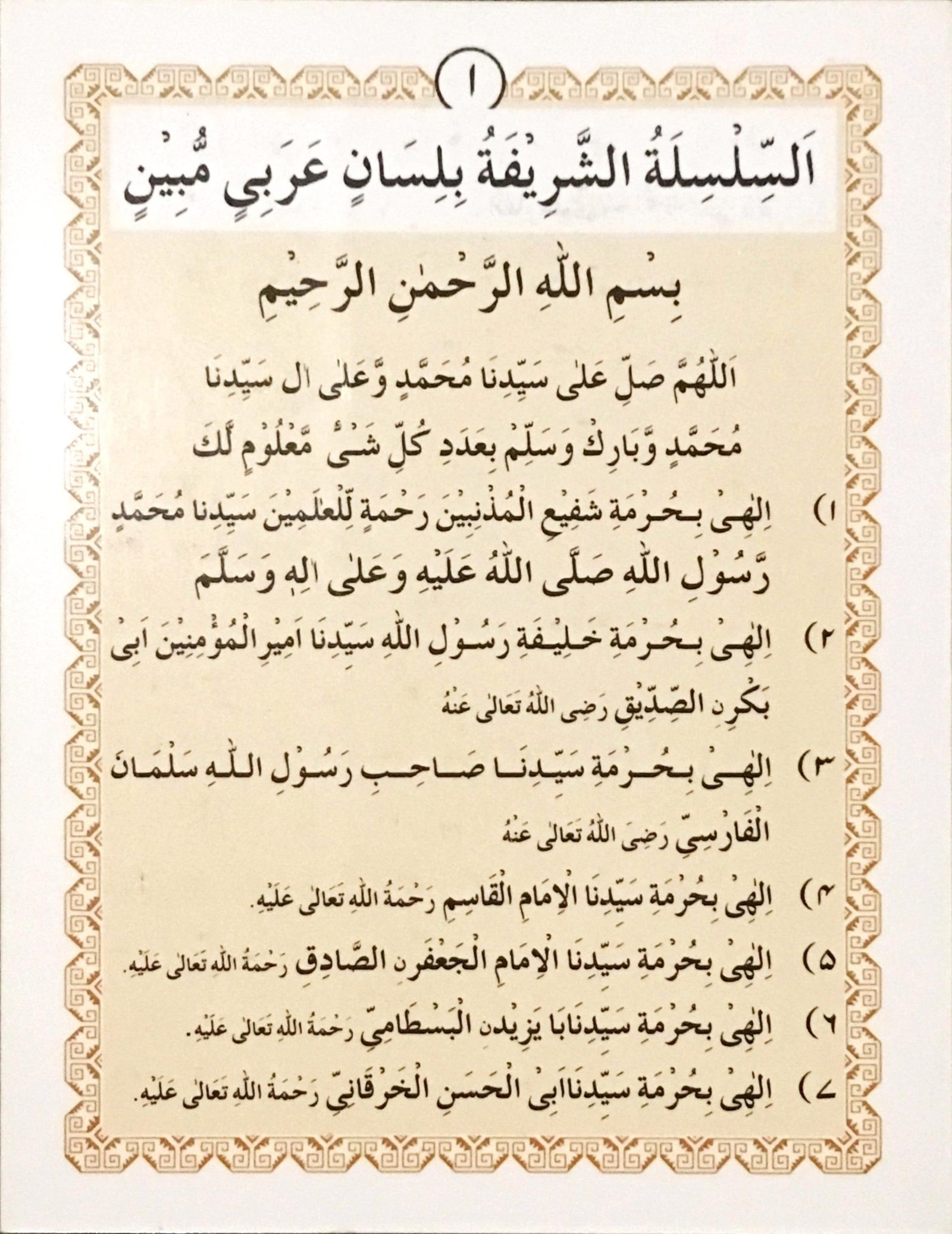


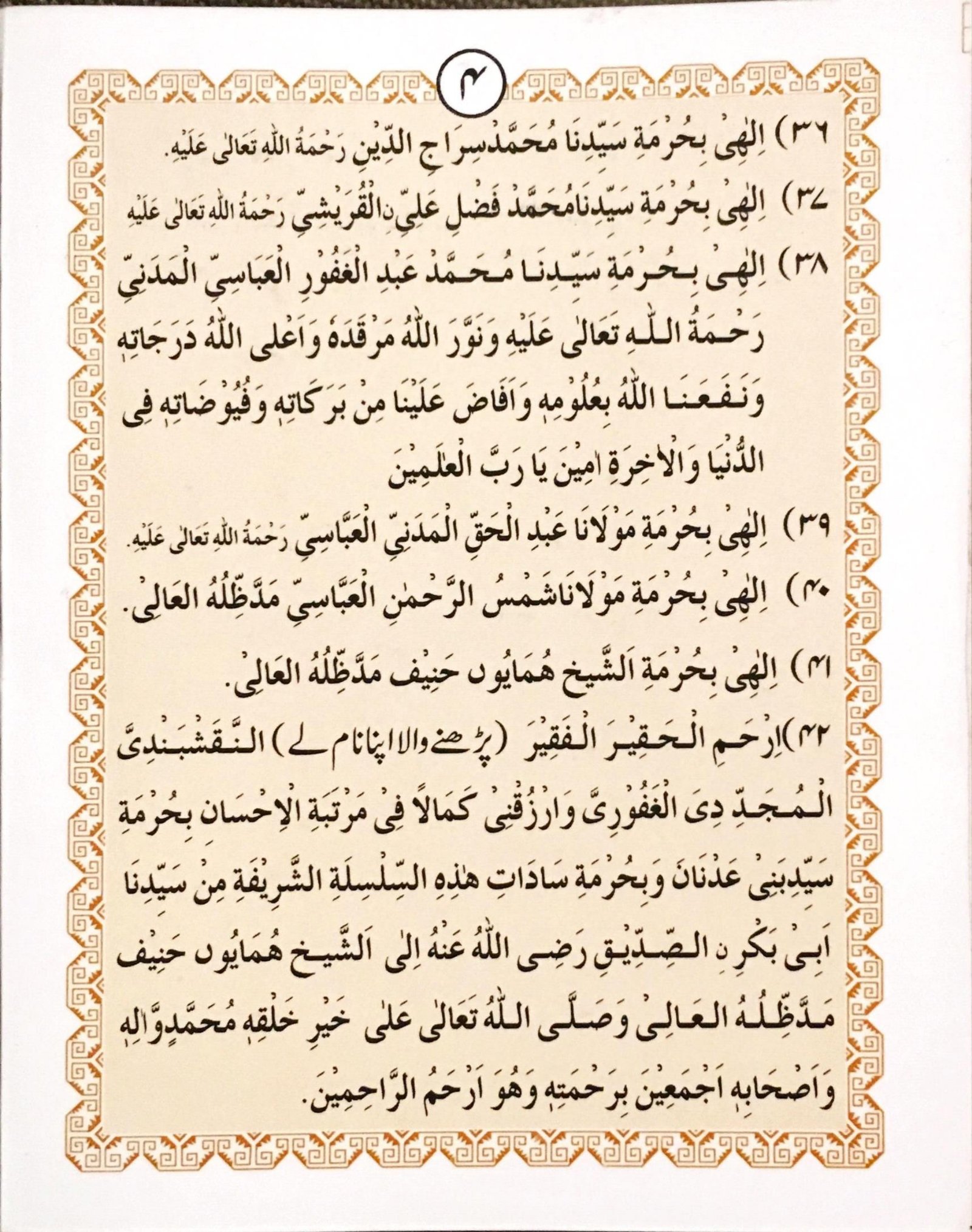
The scanned shajrah, in the original hand, is on the Golden Chain page.
05Raabita
Raabita is communication with the Shaykh. In the Naqshbandi order, it is imperative to seek guidance for spiritual and worldly matters from the Shaykh.
The seeker must contact the Shaykh once every fifteen days, to report his spiritual matters and routines. This also includes matters pertaining to following Shariah and Sunnah. One must report all matters truthfully, without any exaggeration, and follow the Shaykh’s advice regarding those matters.
Note: report the good states and the difficult ones alike. Hide nothing and add nothing. A seeker is warned against becoming his own physician, and against prescribing a remedy for himself.
06Aadaab
Aadaab are the etiquettes with the Shaykh. The seeker cannot reach his destination by following the path of spirituality on his own accord. It is the duty of the Shaykh to connect the seeker with Allah; therefore, the seeker must accept the Shaykh as his teacher and guide and follow him with true integrity.
Seeking advice
- Hazrat Syed Ali Ma’rz’i (rahmatullahi alayh) said, “The seeker must not involve in any activity or a Wazeefa without the prior permission of his Shaykh.”
- The seeker should follow the Shaykh’s guidance in worldly and spiritual matters.
- If the Shaykh’s advice is against the seeker’s wish, the seeker should still follow and trust the wisdom of his Shaykh.
- The seeker must not hide his spiritual matters from his Shaykh.
- The seeker must not expect miracles from his Shaykh.
In his presence
- The seeker must conduct at his best in front of the Shaykh.
- The seeker must be attentive towards his Shaykh and avoid indulging in conversation with others.
- The seeker must refrain from talking in front of his Shaykh. Even if the Shaykh is quiet, the seeker’s heart still benefits from the Shaykh.
- The seeker must neither walk in front of the Shaykh nor show his back to the Shaykh.
- The seeker must not perform Dikr or optional prayers around his Shaykh without his prior permission.
- The seeker should not talk absurd or ask the Shaykh pointless questions.
Respect
- The Shaykh is the teacher and the guide; therefore, one must respect the Shaykh even in his absence.
- The seeker must honor the teachers and the family of the Shaykh.
- The seeker must be extremely respectful and never call out to his Shaykh.
- The seeker must observe and follow the Shaykh in all matters e.g. dressing, ibadah.
- No one has ever reached his spiritual destination without the love and respect towards the Mashaikh.
These are a few of them. The complete list, with the sayings of the Mashaikh on each, is in the book.
Silsila Aaliya Naqshbandiyya Mujaddidiyya Ghafooriyya · falah.org