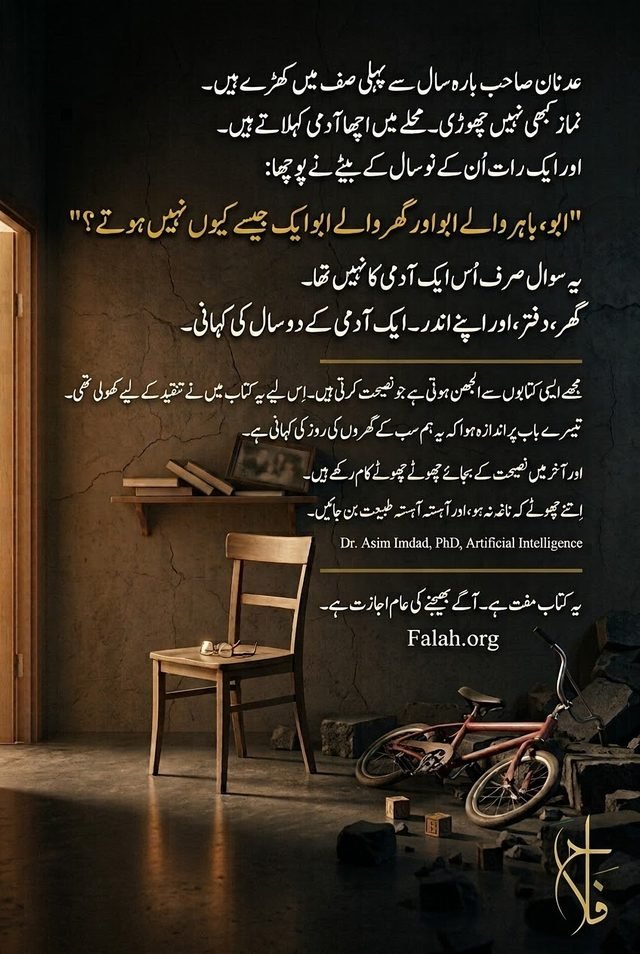
Somewhere in our heads there is a list. The brother. The sister. The husband or the wife. The in-laws. Each name on that list comes with a note: this person needs to change. We spend months, sometimes years, waiting for the people on the list to change, and they do not. Then we say the sentence all of us have said at some point: I treat everyone well, and nobody treats me well. Change yourself first is the one line that never makes it onto the list.
I want to offer you a different list. It has one name on it.
The habit nobody admits to
We are busy worrying about everyone’s reform. This has become a widespread habit: we want every person around us set right. What we have never felt the need to do is stand in front of the mirror and see that we need reform too.
Where does it come from? From something more basic that most of us share. Whenever we deal with someone, our peers, people we know, people we do not know, we start finding faults in them. Even when we do not go looking, their weaknesses show to us quickly. Then, with our brothers and sisters, with friends, with elders, we see those faults and we mock, we belittle. What we forget is that the same faults may be in us. And if there is a flaw in me, that flaw is the first thing I need to work on, before I try to fix anyone else, before I try to reform anyone else.
The common denominator
You hold more than one role at the same time. You are a son, a son-in-law, a brother, somebody’s brother-in-law, sometimes a father-in-law. All of those roles sit in one person, you. And every one of them is a relationship, and a relationship is always between two people: two brothers, a brother and a sister, a husband and a wife, a mother-in-law and a daughter-in-law. Now suppose all of our relationships are off, and we want all of them reformed. There is one thing to notice. In all of those relationships there is a common denominator. One thing is common. And that common thing is us.
If we feel that our brother needs reform, our sister needs reform, our husband or our wife needs reform, our in-laws need reform, then look at who is standing in the middle of all of them. It is possible that we need reform too.
I do not say that to make anyone feel small. I say it because it is the most hopeful thing I know, and here is why.
Change yourself first: what you can actually control
Whatever effort you make to reform another person, there is no guarantee it works. None. But if you become sincere about your own reform, and make the intention that my own reform comes first, that I will bring my actions and my thinking into line with the Sunnah, the way of the Prophet Muhammad ﷺ, then that you can do one hundred percent. Not an iota of doubt. Other people’s change is out of your hands. Your own change is entirely in them.
And once you decide to reform yourself, there is only one question left: into what? We have only one role model for this. Do I want to become like Elon Musk, like Bill Gates, like a footballer, Messi or Ronaldo, like a cricketer? Or like the Prophet Muhammad ﷺ? Allah SWT has declared the Prophet Muhammad ﷺ the best example (mafhoom: Surah al-Ahzab 21). In this whole universe, the most ideal role model we can follow is him ﷺ. And this is not about outward actions alone. His thinking, his intention, his sincerity have to come into us. The Sunnah is to be adopted outwardly and inwardly.
That one model covers every role you hold, the son, the son-in-law, the brother, the brother-in-law, the father-in-law, because the best way to play every one of them is the same: follow the Sunnah of the Prophet ﷺ.
Without that, the home conversation goes one way. Each of us is sure that what I am saying is true, because each of us has done our own analysis, and that analysis stands on information that came from social media, from television dramas, from friends. Decisions built on information from other human beings are sometimes right and sometimes wrong. And underneath every discussion sits one wish: let me win the argument.
The front door
Until we behave the same way outside and inside, in the mosque and at home, until we become the same person, there will be no peace at home. I say it plainly, because here is how it usually goes.
We read the books: how to be a good team member, how to be a good leader. We want to practise all of it in business and career, and we keep our manners for our friends. Then we walk through the front door at home and the leadership books go aside. The laughter and the courtesy we give friends, we do not give at home. There we become a completely different person.
There is a litmus test for this. In an argument at home, we raise our voice, we insult someone, we plan a clever argument just to win, and we know inside that we are doing wrong. If there is not even a sense of it, that is the worst state of the nafs, the inner self. It is called Nafs-e-Ammarah, the self that commands you towards wrong.
So the message is simple. If you want peace in your home, take whatever role you hold, father, son, daughter-in-law, daughter, mother-in-law, and live it by the Sunnah of the Prophet ﷺ and the commands of Allah SWT. That is where the blessing is, and that is where the peace is.
Tonight, before you open your front door, stop for one moment and make the intention: my own reform comes first.
May Allah SWT give us the honesty to look at ourselves before anyone else, and the strength to begin. Ameen.
Full video: https://youtu.be/PT4JUPRaI4c
The next piece, Three Stages of Nafs, is about Nafs-e-Ammarah, Nafs-e-Lawwamah and Nafs-e-Mutma’innah: https://falah.org/three-stages-of-nafs-which-one-are-we-in/
Join us on the WhatsApp Channel: https://falah.org/newsletter