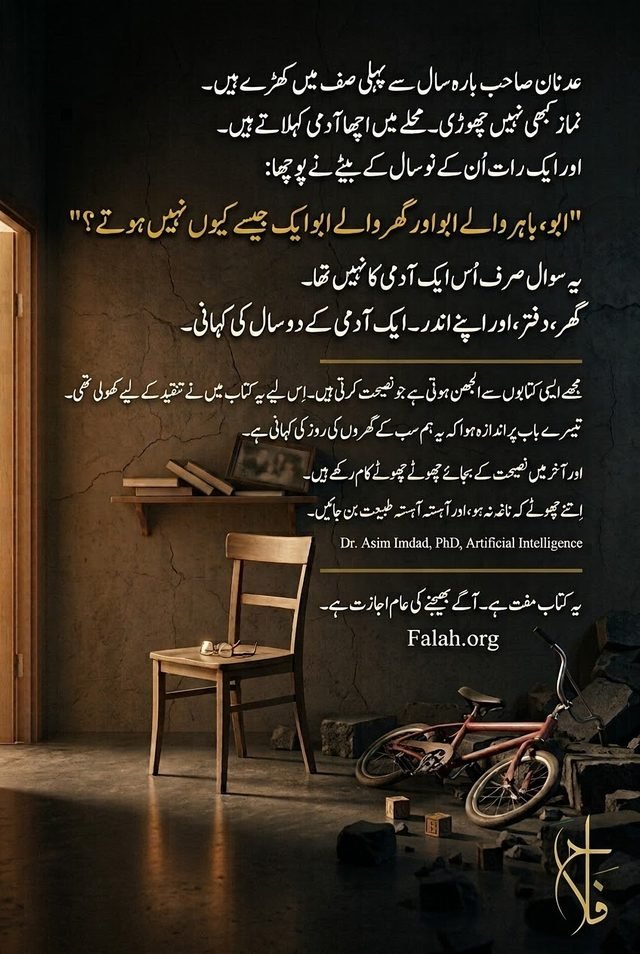
Somebody at home gives us advice. Our brother, our parents, our husband or our wife. And before they have finished, we already know: they are wrong, I am right. What I think, what I say, what I do, is right. We have reasons for everything, incidents to quote, he said this, his mother said that at the time, and that is why I am doing this. Whatever we do, we have an argument ready for it, and inside there is no unease at all that we did wrong. Of the three stages of nafs, that is the first.
That scene is where I want to begin, because it tells us which of the three stages of nafs, the inner self, we are standing in. And until we are the same person in the mosque and at home, there is no peace at home. That is where this whole matter starts.
What is the nafs, and what are the three stages of nafs?
Ask most of us to define the nafs and we would struggle. We use the word, we hear it in talks, and yet in today’s life we do not know its basic definition. That is unfortunate, because Allah SWT has tied success itself to this one thing. He swore seven oaths in the Quran, by His own great creations, and then said that whoever purifies the nafs, he alone succeeds (mafhoom: Surah ash-Shams 9). Seven oaths before one statement. So it is worth knowing what the nafs is and what state ours is in tonight.
The nafs is what we usually call the inner self. Allama Iqbal (may Allah have mercy on him) calls it Khudi. And in the Quran, Allah SWT has described three states of it. I want you to see all three not on a page but in your own living room.
Nafs-e-Ammarah: the conscience is dead
The worst state of the inner self is Nafs-e-Ammarah, the self that commands you towards wrong. The Quran preserves the words of a Prophet (peace be upon him) of the highest rank about it. Hazrat Yusuf (peace be upon him) said: I do not declare my nafs free of blame; the nafs surely urges towards evil (mafhoom: Surah Yusuf 53). The Prophets (peace be upon them) are protected from sin, and still, for our tarbiyat, our inner training, those words were recorded so that every human being until the Last Day could know what a Prophet (peace be upon him) said about the nafs. Nobody can take a guarantee about his own nafs.
Now run the test at home. In an argument, do we raise our voice? Do we insult someone? Do we plan a clever line just to win, while knowing inside that it is wrong? And afterwards, do we feel anything at all? If there is not even a sense of it, that is the worst state of the nafs. The person at the start of this piece, with a reason ready for everything and no unease inside, is living in that state. That state is Nafs-e-Ammarah.
It has another face. We do something wrong and then tell our friends with pride: look how I fooled him, look how I tricked him. At home we tell our parents and siblings: see how I handled the situation, how I put them in their place. Taking pride in a wrong, in an act that hurt someone, that broke someone’s heart, is the worst state of the nafs. For success, the very first task is to move the nafs out of this state.
Nafs-e-Lawwamah: the conscience comes alive
In our society we use phrases like these: your conscience has gone to sleep, your conscience is dead, your conscience is alive. All of them come from here. The second state of the nafs is an improvement on the first. It is Nafs-e-Lawwamah, the self-reproaching self, and Allah SWT swears by it in the Quran: and I swear by the self-reproaching nafs (mafhoom: Surah al-Qiyamah 2).
What is the self-reproaching nafs? We made a mistake. We scolded someone, we were rude to someone, at home, among friends, at the office. And afterwards we realised: yes, I was wrong. Now we will not boast to anyone that we fooled someone or wronged someone. Instead we feel the reproach, we are ashamed inside. That is our Nafs-e-Lawwamah.
Think of it as moving from zero to fifty percent. We will still make mistakes, still be rude to someone, still wrong someone, but alongside it there is a sense of it: I am doing wrong. And there is a worry about fixing ourselves: how do I become right, I should find a way. In Nafs-e-Ammarah the conscience is dead. In Nafs-e-Lawwamah it has come alive.
Nafs-e-Mutma’innah: pleased with whatever Allah SWT is pleased with
Whoever takes his nafs from Nafs-e-Ammarah to Nafs-e-Lawwamah, and through Nafs-e-Lawwamah to Nafs-e-Mutma’innah, the contented self, Allah SWT loves him and waits for him. That third state is the key to our success. So what is Nafs-e-Mutma’innah?
In the Fajr prayer, the imam often recites the verse of Surah al-Fajr whose meaning is: O contented soul, return to your Lord, pleased with Him and He pleased with you (mafhoom: Surah al-Fajr 27-28). A nafs that becomes content with whatever Allah SWT is pleased with. That is Nafs-e-Mutma’innah, and that is the success.
Think about what is being said there. Allah SWT is saying: now you have succeeded, I am pleased with you, come to Me. The way a beloved calls the one who loves him, Allah SWT is calling you.
One thing to do today: analyse the state of your own nafs, at home, where it shows most. Take one mistake from today and ask only this: did I feel it, or not? Knowing where you stand is where the journey begins, and the journey leads back to the one thing we started with: success lies in purifying the nafs.
May Allah SWT give us the honesty to see the state of our own nafs, and the strength to move it upward. Ameen.
Full video: https://youtu.be/dm82WopHzBA
This piece in Urdu: https://falah.org/?p=4035
Join us on the WhatsApp Channel: https://falah.org/newsletter