You have read the books. Leadership, time management, how to be a good team player, gratitude. We have all read them. And here is what happens to almost all of us: all of that good material is for the office and for friends. The moment we walk through the front door at home, the leadership books go aside and the manners stay outside. At home we become a different person. That is where peace at home begins to slip.
I want to talk to you about that person. Our personality, and the success or failure that follows from it, is shaped mostly by our environment, and the biggest part of our environment is home. If the home is favourable to us, we can become good team players, good leaders, successful people. Home is the foundation. So if we want to fix anything outside, the work begins inside the house, and inside us.
The one person in every relationship
When family members talk, each of us is sure that what I am saying is true. Why? Because each of us has done our own study, our own analysis, and reached a conclusion. That analysis is built on information. And where does the information come from? Usually social media, television dramas, friends. A decision built on information that came from other human beings is never the ideal decision. Sometimes it turns out right, sometimes it does not.
We run our homes, our offices and our businesses on these decisions, and when they fail we are left with one thought: I treat everyone well, nobody treats me well. The brother’s advice is wrong. The parents’ advice is wrong. The husband’s or the wife’s advice is wrong. Whatever I think and whatever I do is right, and I have a list of reasons and incidents ready to prove it.
Hold on to that picture. It is the picture of a particular state of the nafs, the inner self, and we will come back to it.
Now look at the relationships in our own lives. A relationship is always between two people: a husband and a wife, a mother-in-law and a daughter-in-law, two brothers, a brother and a sister. If we feel that all of our relationships are off, that our spouse needs reform, our in-laws need reform, our brother and our sister need reform, then notice the one thing common to all of them. It is us. We are standing in the middle. So it is possible that we need reform too.
Why do we miss this? Because most of us share one habit. Whenever we talk to someone, their flaws start showing to us quickly. We notice, we sometimes mock, and we forget that the same flaws could be in us. We want everyone around us fixed. What we almost never do is stand in front of the mirror and see that we need reform too.
And here is the part I say with complete confidence. Whatever effort you make to reform someone else, there is no guarantee it works. But if you become sincere about your own reform, and make the intention that my own reform comes first, that I will bring my actions and my thinking in line with the Sunnah, the way of the Prophet Muhammad ﷺ, then that you can do one hundred percent. Not an iota of doubt.
Which model are we copying?
If I am going to reform myself, the question is: into what? Do I want to become like Elon Musk, like Bill Gates, like a footballer, like a cricketer? Or like the Prophet Muhammad ﷺ? Allah SWT has declared the Prophet Muhammad ﷺ the best example (mafhoom: Surah al-Ahzab 21). In this whole universe, the most ideal role model we can follow is him ﷺ. And not only his outward actions; his thinking, his intention, his sincerity have to come into us. The Sunnah has to be adopted outwardly and inwardly.
This matters because you hold many roles at the same time. You are a son, a son-in-law, a brother, a brother-in-law, sometimes a father-in-law. All of those roles sit with you, in one person. The best way to play every one of them is the same: follow the Sunnah of the Prophet ﷺ.
Peace at home: a test you can run tonight
Until we behave the same way outside and inside, in the mosque and at home, until we become the same person, there will be no peace in the home. I say that plainly, because it is the whole matter.
There is a litmus test for it, and you can run it tonight. In an argument at home, do we raise our voice? Do we insult someone? Do we plan a clever line just to win, while knowing inside that it is wrong? And after all that, do we feel nothing? If there is no sense of it at all, that is the worst state of the nafs, the inner self. It is called Nafs-e-Ammarah, the self that commands you towards wrong. It is the state of the person at the start of this piece, the one with the list of reasons.
The second state is better. We scold someone, we are rude to someone, at home or at the office, and afterwards we feel it: yes, I was wrong. We will not boast about it to anyone. We feel the reproach, we are ashamed inside. That is Nafs-e-Lawwamah, the self-reproaching self. Our conscience has come alive. And the third state is Nafs-e-Mutma’innah, the contented self: a nafs that is pleased with whatever Allah SWT is pleased with.
Who gets to define success
We take our definition of success from whatever we hear around us. Allah SWT, in the Quran, swore seven oaths and then said that whoever purifies the nafs, he alone succeeds (mafhoom: Surah ash-Shams 9). Seven oaths by His own great creations before one statement. That is how important purifying the nafs is.
And this success is not only for the hereafter. Many of us have decided that gaining this world costs the hereafter, and gaining the hereafter means leaving this world. There is nothing like that. Success in the hereafter and success in this world are on one path. Only, this world has to be lived by the ways and the Sunnah of the Prophet Muhammad ﷺ. He never forbade us business, and he never forbade us good provision.
So my message is this. If you want peace in your home, take whatever role you hold, father, son, daughter-in-law, daughter, mother-in-law, and live that role by the Sunnah of the Prophet ﷺ and the commands of Allah SWT. That is where the blessing is, and that is where the peace is.
One thing to do today: before you sleep tonight, take one exchange you had at home and ask only this of yourself. Did I feel anything? Not what the other person did. What I felt.
May Allah SWT give our homes the peace that begins with our own reform. Ameen.
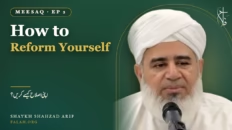
The full talk is on video: https://youtu.be/UWC8cPBmF6Q
This piece in Urdu: https://falah.org/%da%af%da%be%d8%b1-%da%a9%d8%a7-%d8%b3%da%a9%d9%88%d9%86-%d8%b4%d8%b1%d9%88%d8%b9%d8%a7%d8%aa-%d8%a7%d9%be%d9%86%db%92-%d8%a2%d9%be-%d8%b3%db%92/
Read the first piece in this series, Change Yourself First: https://falah.org/change-yourself-first-the-one-person-you-can-reform/
The next talk comes to you first on our WhatsApp Channel: https://falah.org/newsletter