There is a particular silence after we have fallen.
Picture the day of the gathering of remembrance, the one we have sat in for years. The hour is near. Our phone lights up on the table. A friend from the circle: Coming today?
We type yes. We delete it.
Last night something happened that had not happened in a long time. An old habit. A weak hour.
We asked Allah ﷻ for forgiveness that same night, again and again. But asking alone in a dark room is one thing. Walking back into a room full of good people is another.
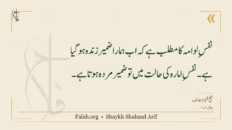
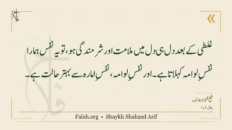
And a voice inside puts it plainly:
◆ With what face can I go?
◆ The Shaykh will scold me. Or he will be disappointed.
◆ After all the effort he put into me.
We often think this sentence, and often say it aloud.
On a journey, we were reading chapter seventeen of Ikmalush Shiyam. The chapter is about suhbat, companionship: keeping company, sitting near people whose hearts are with Allah ﷻ.
And in that lesson came the sentence we all say. I have done so much wrong. How can I go and sit with the Shaykh? With what face can I go?
A way back, even after a hundred
There is a sound hadith most of us have heard.
A man had taken ninety-nine lives. One day the thought came to him that he must repent. He went to a scholar and asked. The answer he got was that his repentance could never be accepted.
Out of frustration, he killed him too. A hundred.
Then the feeling returned, heavier than before. People sent him to another scholar, and he asked the same question. I have killed a hundred people. What road is left for me?
This time the answer was:
“Your repentance is entirely possible, and between you and your repentance nothing stands in the way, with Allah ﷻ.”
Mafhoom: Bukhari 3470, Muslim 2766
And with it came a single piece of counsel:
“Go towards the town of the righteous.”
Mafhoom: Bukhari 3470, Muslim 2766
He set out. Somewhere on the road, his time of death came.
Two kinds of angels arrived. Some wished to carry him towards Paradise because of his repentance, others towards Hell because of his sins. Guidance was asked of Allah ﷻ, and it came: measure the distance. If he is nearer the town of the righteous, the angels of Paradise will take him.
“By Allah's ﷻ wisdom, by Allah's ﷻ mercy, that distance of the earth grows shorter there.”
Mafhoom: Bukhari 3470, Muslim 2766
Read it again, slowly.
He had not yet sat down among the righteous in their town.
He never reached the town. He had only set out, with repentance in his heart.
We tell ourselves we have sinned too much for repentance. This hadith says otherwise: however much we have done, forgiveness is possible. And another hadith tells us how long the door stays open:
“Until the death rattle comes, Allah ﷻ keeps the doors of repentance open.”
Mafhoom: Tirmidhi 3537
The voice that whispers it is too late for you is the deception of Shaytan.
Whose voice is it, really?
Go back to that voice at the door and listen carefully. He will scold me. He will be disappointed. After all his effort. Every one of these thoughts comes from Shaytan.
He does not take us by the hand and make us sin. The ones who take us by the hand are the friends and companions we keep. His work is the waswasa, the whisper. And sometimes, after we fall, his wish is simple: that we are cut off from our Shaykh.
Shaytan only whispers. It is the company we keep that takes us by the hand.
But there is another fear too: that they will know our faults. Here the book turns the fear around:
“In truth, your real companion is the one who knew your faults and still stayed with you.”
Source: Ikmalush Shiyam, chapter 17
And the book goes on:
“And there is none like that except your Lord, Most High.”
Source: Ikmalush Shiyam, chapter 17
And the commentary explains it:
“The common way of people is that when one comes to know another's fault, they stop coming and going to him, and aversion towards him is born in the heart; but Allah ﷻ sees the hundreds of thousands of faults of His servants at every moment, and still does not leave His servant.”
Source: Ikmalush Shiyam, chapter 17
The people of Allah ﷻ hear our mistakes and try to help us mend. They see even our biggest fault, and cover it. They do not break the tie.
I know this from my own life. I know the state I was in when I first met my Shaykh, my teacher on this path. He accepted me. He sat and listened to me.
I still remember the things I used to say in those early days. Very fine things, I thought. It was the largeness of his heart that he sat there and listened.
So this lesson is for all of us, and for me too. Sometimes things are so good that we wonder how to even tell our Shaykh. Sometimes we have slipped, and we wonder what we could possibly say.
These are two extremes, and in both the answer is the same: go to him, and tell him, this is where I am. With complete neutrality. Setting our own mind to one side.
Whose company is worth keeping?
The town of the righteous has many good people. But a heart is trained by sitting near one of them, often and long.
My Shaykh always recites this verse, which has always been in the Quran and always will be:
“Be with the truthful.”
Mafhoom: Surah at-Tawbah 9:119
And in another place the Quran says:
“Keep the company of those whose hearts are immersed in the remembrance of Allah ﷻ.”
Mafhoom: Surah al-Kahf 18:28
My Shaykh once gave an example from business. A manufacturer who sits with traders soon wants to trade. A trader who sits with manufacturers soon wants to open a factory. The heart begins to want what the people beside it want.
So whom should we sit beside? The first point of this chapter is a test:
“Do not take up the gatherings of a person whose state does not stir you towards Allah ﷻ, and whose speech does not guide you to Allah ﷻ.”
Source: Ikmalush Shiyam, chapter 17
In other words: if sitting near someone does not wake a longing in us for Allah's ﷻ love and nearness, or make it grow, the heart takes nothing from that room. However he looks from outside, if his heart is full of the world, we keep our distance.
The second point is gentler, and harder. We are always comparing ourselves with our own circle. That is human: among people worse than us, we will try to be better than them, and among the righteous, we will try to better ourselves too.
But there is a trap. In a circle where nobody prays at all, we pray Fajr, or give a little in charity, and quietly we begin to think of ourselves as the pious one. Then we stop seeing our own faults, and we fall into ujb, self-admiration. So the chapter says:
“Whoever is better than you in faith, keep his company, for by staying with him you will see your own faults and care about putting yourself right.”
Source: Ikmalush Shiyam, chapter 17
And here we have to straighten our own measure. From a few books and some social media, we build an image: someone who floats in the air, calls us by name the moment he sees us, and solves everything overnight. Only when every box is ticked will he be worthy to be our Shaykh.
No. The measure this chapter gives is this: his heart is taken up with the remembrance of Allah ﷻ, he wants nothing from us for himself, and he is better than us in faith. And each of us knows our own state very well.
And the last point. Nearly everyone we meet today, we meet for some benefit. A meeting, a round of golf. Something always comes of it, but it is of this world.
When we sit with the people of Allah ﷻ, they want nothing from us for themselves. They are only working for our good.
The people of Allah ﷻ meet us for one benefit only: ours.
Contact hours for the heart
And once we have found such a person, what then?
Think of university. Whether we are becoming doctors or engineers, the books are there, and now the online classes too. Still we go and sit in the classroom with the teacher.
We take extra classes, and tuition in the evening. Why? To increase our contact hours.
In today's language, think of suhbat as contact hours. The more contact hours, the more benefit.
With one difference. The skill we learn there may serve us for four or five years. What we learn here is what our success depends on, in this life and in the life that never ends after it.
That is why we travel with our Shaykh, and stay sitting after the talk is over. We are only increasing our contact hours.
The next gathering will come. The phone will light up again. And perhaps that voice will too: with what face?
This time, recognise it. The man on the road did not wait until he was fixed. He set out towards the righteous with repentance in his heart, and mercy folded the road for him.
So this time, send the yes. Go, sit down, and tell our Shaykh: this is where I am.
One thing for today
- If a weak moment has kept us away from a gathering of the people of Allah ﷻ, go back this week. Not once we are fixed. In order to be fixed.
- Write down the measure: the one near whom the longing for Allah ﷻ wakes up, who is ahead of us in faith, and who wants nothing from us.
- And when the talk ends, do not get up at once. Sit a little longer.
May Allah ﷻ give all of us, me as well as all of you, the understanding of this and the strength to live by it. And whenever we fall, may our next step be towards His righteous servants. Ameen.
Listen to the full talk here:
For our weekly Majlis, the WhatsApp Community and the free book: